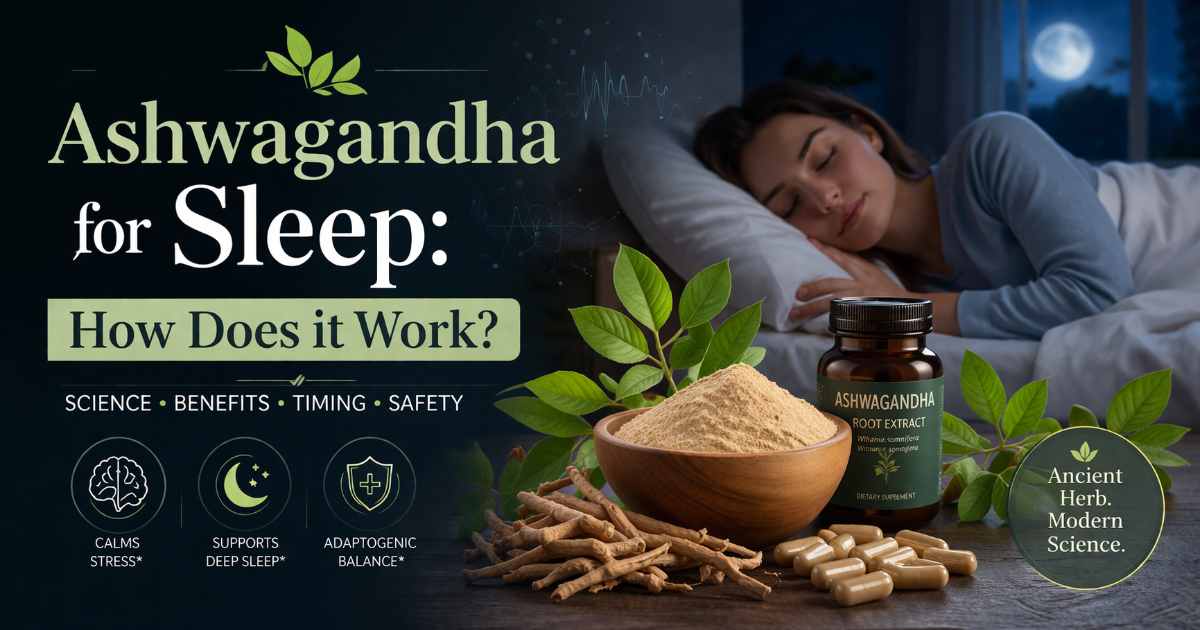
Ashwagandha for Sleep: How Does Iat Work?
Content Summary
Ashwagandha for sleep may help some people, especially when poor sleep is linked with stress or mild insomnia.
Current research suggests small but meaningful improvements in sleep quality, sleep efficiency, and sleep onset in some short-term studies.
The evidence is promising, but still limited by small sample sizes, short duration, and variation in supplement formulas.
The best ashwagandha for sleep is not simply the most advertised product. It should be clearly labeled, standardized, and used with medical awareness.
Readers should pay close attention to when to take ashwagandha for sleep, possible interactions, and potentially serious side effects of ashwagandha.
People who are pregnant, breastfeeding, near surgery, or living with thyroid, autoimmune, or medication-related concerns should speak with a clinician first.
Ashwagandha is a botanical used in traditional Ayurvedic practice and commonly marketed today for stress, anxiety, and sleep support. It is often described as an adaptogen, though NIH’s Office of Dietary Supplements notes that this term is used loosely. Most commercial supplements contain root extract, while some use root-and-leaf combinations.
Sleep supplements are often marketed as quick fixes. Ashwagandha is different from a classic sedative-style sleep aid because it may help sleep indirectly, especially when stress and mental overactivation are part of the problem. That distinction matters. Many readers searching for “ashwagandha for sleep” are not asking whether it knocks you out like a drug. They want to know whether it can help them feel calmer, fall asleep more easily, or wake less often during the night.
The best answer is nuanced. NIH’s Office of Dietary Supplements says a small number of studies suggest that ashwagandha extract may improve sleep quality, sleep efficiency, total sleep time, and sleep latency, with stronger effects seen in people with insomnia. But the same source also makes clear that the research base is still limited and that long-term safety is not well established.
This article explains how it may work, what the evidence actually shows, how to evaluate the best ashwagandha for sleep, when to take ashwagandha for sleep, and the potentially serious side effects of ashwagandha that too many supplement blogs gloss over.
1. Ashwagandha for Sleep: What It Is and Why People Use It
Ashwagandha, also known as Withania somnifera, is an herb used in traditional Ayurvedic medicine. NIH notes that most supplements on the market contain root extract, although some contain both root and leaf. The species name somnifera is linked to sleep-inducing associations, which helps explain why so many supplement brands position it as a nighttime wellness product.
Interest in ashwagandha for sleep has grown because it sits at the intersection of two major consumer needs: stress reduction and better rest. Many adults are not dealing with a pure sleep problem in isolation. They are dealing with overthinking, pressure, fatigue, and nervous system overload. In that context, a supplement that may support a calmer stress response can sound appealing.
What makes ashwagandha especially relevant is that several studies summarized by NIH found improvements not just in perceived stress and anxiety scores, but also in sleeplessness, fatigue, and sleep quality. That does not make it a cure. It does suggest that some of the reported ashwagandha benefits are connected to how the body handles stress rather than to a direct sedative effect alone.
For readers, the key takeaway is simple:
Ashwagandha is not best understood as a standard sleeping tablet
It may be more useful when stress is part of the sleep problem
Product quality and personal safety matter as much as the herb itself
2. How Does Ashwagandha for Sleep Work in the Body?
When people ask, “How does ashwagandha for sleep work?” the most practical answer is this: it may help sleep by supporting a calmer stress response.
NIH’s health professional fact sheet says research suggests ashwagandha extracts may lower stress, anxiety, and cortisol levels. In several trials, people taking ashwagandha reported less stress and better sleep quality than placebo groups. That means the sleep benefit may be partly downstream of stress regulation.
This matters because stress-driven sleep issues often look like:
trouble falling asleep because the mind is still active
waking in the night with tension or rumination
feeling tired but unable to settle
non-restorative sleep after high-pressure days
Ashwagandha contains phytochemicals including withanolides and alkaloids. NIH notes that withanolides are believed to be responsible for many proposed effects, but other compounds may also be involved. In other words, the mechanism is still being studied and should not be oversimplified into one marketing slogan.
A helpful way to explain it for readers is:
Stress may make sleep lighter, later, or more fragmented
Ashwagandha may reduce perceived stress in some people
Lower stress may improve the conditions needed for better sleep
That is more accurate than saying it “puts you to sleep.”
3. What the Research Says About Ashwagandha Benefits for Sleep
The current evidence is encouraging, but not strong enough to justify exaggerated claims.
NIH states that a small number of studies suggest ashwagandha extract may improve sleep quality, sleep efficiency, total sleep time, and sleep latency. These benefits appear to be more noticeable in people with insomnia than in people who already sleep reasonably well.
A 2021 systematic review and meta-analysis summarized by NIH included five studies with 372 adults using ashwagandha or placebo for 6 to 12 weeks. Overall, ashwagandha had a small but significant effect on sleep, with stronger benefits when the dose was 600 mg/day, treatment lasted at least 8 weeks, and participants had insomnia.
Quick research snapshot
This is useful, but it also reveals the limits:
trials were relatively short
many were conducted in India
supplement formulations differed
long-term outcomes remain unclear
That is why a responsible article should say the evidence is promising, not definitive.
4. Best Ashwagandha for Sleep: What to Look for Before You Buy
The best ashwagandha for sleep is not just the one with the loudest marketing. It is the one that aligns best with the evidence and gives the consumer enough label transparency to judge quality.
NIH notes that studies have used both root-only extracts and root-and-leaf extracts, with doses commonly falling between 250 and 600 mg/day depending on the formulation. NIH also notes that many extracts are standardized for withanolide content.
What to look for:
Clearly stated plant part: root only, or root + leaf
Standardization details: for example, percentage or amount of withanolides
Transparent dosage per serving
Simple ingredient list
Reputable manufacturing and third-party testing
NCCIH also reminds consumers that dietary supplements are not approved by the FDA before they are sold, and that manufacturers are responsible for product safety and labeling. That is a major reason to be careful with bargain, vague, or overhyped products.
A practical reader-friendly rule is this:
“Best” should mean well-labeled, evidence-aligned, and professionally appropriate
“Best” should not mean “strongest possible dose” or “most viral product”
5. When to Take Ashwagandha for Sleep for Best Results
When to take ashwagandha for sleep depends on why you are using it and how your body responds.
There is no single official time recommended by NIH or NCCIH for everyone. What the evidence does show is that beneficial results in sleep studies were achieved through daily use over several weeks, not from one-off emergency use the night before a stressful event.
A practical framework:
If your goal is general stress support, some people take it earlier in the day
If your goal is sleep support, evening use may be more intuitive
If a product causes drowsiness or stomach upset, timing may need adjustment
NCCIH and MSK both note that drowsiness can occur in some people. That means first-time users should be cautious and avoid assuming they will react the same way as someone else.
For educational content, the safest wording is:
Start low if your clinician agrees
Take it consistently rather than randomly
Watch how you respond over time
Do not combine it casually with other sedating products
6. Ashwagandha for Sleep Dosage, Forms, and Routine Tips
Study-backed ranges matter more than trend-driven guesswork.
NIH reports that the sleep studies used doses ranging from 250 to 600 mg/day of root extract, with one study using 120 mg/day of a root-and-leaf extract. Benefits in the meta-analysis were more prominent at 600 mg/day and after at least 8 weeks.
Common formats include:
capsules
tablets
powders
gummies
liquid extracts
Capsules and tablets are usually the easiest for dosage consistency. Powders may work for some people, but exact standardization can be less obvious depending on the product.
Routine tips:
Pick one product and stay consistent
Avoid mixing multiple new supplements at once
Track sleep, stress, digestion, and daytime drowsiness
Reassess after several weeks, not several hours
This is where many readers go wrong. They search for ashwagandha benefits, buy a random product, take it twice, and expect a dramatic overnight result. The available evidence does not support that mindset.
7. Potentially Serious Side Effects of Ashwagandha You Should Know
This is the section many articles bury, but it is essential.
NCCIH says ashwagandha may be safe in the short term, up to about 3 months, but there is not enough information to draw conclusions about long-term safety. Common side effects include drowsiness, stomach upset, diarrhea, and vomiting. NCCIH also notes that, although rare, there have been a number of cases linking ashwagandha supplements to liver injury.
NIH’s ODS adds that common side effects are usually mild, but there are reports of more serious adverse effects including liver-related issues and possible effects on thyroid function.
MSK provides additional case-report detail, including:
liver injury
thyrotoxicosis
kidney transplant rejection in a case report
possible additive sedative effects with certain drug classes
Common vs serious concerns
More common
stomach upset
loose stools
nausea
drowsiness
Potentially more serious
liver injury
thyroid overstimulation in susceptible people
risky interactions with sedatives or certain medications
This is why “natural” does not automatically mean harmless.
8. Who Should Avoid Ashwagandha for Sleep or Talk to a Clinician First?
According to NCCIH, ashwagandha should be avoided during pregnancy and should not be used while breastfeeding. It is also not recommended for people who are about to have surgery or for those with autoimmune or thyroid disorders.
NCCIH further notes evidence of interactions with medications used for:
diabetes
high blood pressure
immunosuppression
sedation
seizures
thyroid hormone support
MSK also notes possible additive effects with anticonvulsants, barbiturates, and benzodiazepines.
This means a clinician or pharmacist conversation is especially important if you:
take prescription medication
have thyroid disease
have liver concerns
are preparing for surgery
are immunocompromised
are pregnant or breastfeeding
That is not alarmism. It is basic supplement safety.
9. Ashwagandha Benefits Beyond Sleep: Stress, Anxiety, and Recovery
The broader reason people use ashwagandha is not sleep alone. NIH says several clinical trials suggest ashwagandha extracts may help reduce stress and anxiety, and in some studies they also lowered cortisol levels and improved reported well-being.
This matters because sleep and stress are tightly connected. If a supplement helps reduce perceived stress, sleep may improve as a secondary outcome. That is one reason the ashwagandha benefits conversation should not be reduced to only bedtime use.
Still, responsible content should separate supported uses from overblown ones. NCCIH says there is not enough evidence to determine whether ashwagandha is helpful for many other widely advertised conditions.
A clean expert takeaway:
Better supported: stress support, some short-term sleep outcomes
Less certain: many broader claims common in supplement marketing
Best use case: readers who want cautious, short-term, clinician-aware experimentation rather than miracle promises
10. Is Ashwagandha for Sleep Worth Trying? A Smart Decision Checklist
For the right person, ashwagandha for sleep may be worth considering. But “right person” is doing a lot of work in that sentence.
It may be reasonable to consider if:
sleep problems seem linked to stress
you want a non-prescription option
you do not have major contraindications
your clinician agrees it is appropriate
It may not be the right choice if:
you are pregnant or breastfeeding
you have thyroid or autoimmune concerns
you take medications with interaction risk
you want a guaranteed, fast-acting sleep aid
you plan to self-dose without checking product quality
Smart decision checklist
Choose a clearly labeled product
Check the plant part and standardization
Review timing and dosage carefully
Watch for digestive, sedative, liver, or thyroid-related symptoms
Stop and seek help if red flags appear
Reassess whether stress management, sleep hygiene, or medical evaluation is the better fit
FAQs
1. Does ashwagandha make you sleepy right away?
Not necessarily. The better interpretation of the evidence is that ashwagandha may help some people sleep better over time, especially when stress contributes to their insomnia. NIH’s review points to short-term improvements across several weeks, not instant sedation for everyone.
2. When to take ashwagandha for sleep?
There is no universal best time. Many people consider evening use for sleep goals, but timing depends on tolerance, formulation, and the reason for use. What matters most is safe, consistent use rather than random timing.
3. What is the best ashwagandha for sleep?
The best ashwagandha for sleep is typically one with clear labeling, standardized extract details, a reputable manufacturer, and straightforward dosing. “Best” should mean quality and evidence alignment, not hype.
4. What are the potentially serious side effects of ashwagandha?
Rare but important concerns include liver injury, thyroid-related effects, and clinically meaningful interactions with some medications. These are not the most common outcomes, but they are serious enough to justify caution.
5. Can I take ashwagandha with sleep medication?
You should not assume that is safe. NCCIH and MSK both note interaction concerns with sedatives and other medications. A pharmacist or clinician should review your combination first.
6. Is ashwagandha safe for long-term use?
Current authoritative sources say long-term safety is not well established. Most supportive evidence and tolerability data are for short-term use, generally up to around 3 months.
7. Who should avoid ashwagandha?
Pregnant or breastfeeding individuals, people preparing for surgery, and those with autoimmune or thyroid disorders should avoid or carefully review use with a clinician. Medication users should also check for interactions first.
If you are considering ashwagandha for sleep, treat it like a real health decision, not a casual wellness trend. Choose a transparent product, review your medications and health history, and use evidence-based expectations. If you have ongoing insomnia, thyroid issues, liver concerns, or prescription medications, speak with a qualified clinician or pharmacist before starting. That one step can prevent a poor supplement choice and help you find the safest route to better sleep.
Powered by Froala Editor